


Second Edition | Report Date: April 2026
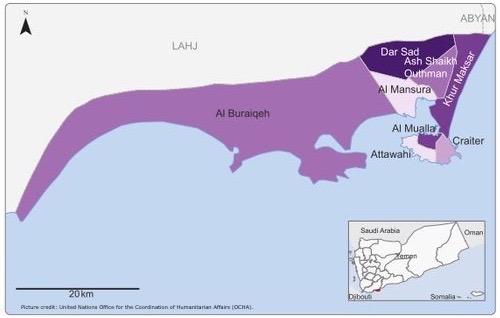
Geographical Scope: The Capital, Aden (Sheikh Othman, Al Mansoura, Al Mualla, Khormaksar, Al Buraiqeh, Dar Saad, Sira, Al Tawahi)
Field Report Summary
Overview
The deteriorating security situation—represented by bloody clashes and an escalation in systematic assassinations—has become the most dangerous indicator affecting the city’s stability. Worsening service crises are now causing temporary internal displacement in some neighborhoods, while rapidly shifting political dynamics and unregulated refugee influxes compound urban risks and escalate societal tension.
A Success Story for the “Radar Aden” Platform
From Field Monitoring to Effective Response
Building on the “Radar Aden” platform’s efforts to transform field assessment data into tangible responses that improve citizens’ lives, we are proud to document an exceptional success achieved in the Al Mualla district during April 2026. Based on a critical alert issued by platform volunteers in the March report regarding an environmental disaster in Al Mualla—specifically, the chronic overflow of sewage perfectly coinciding with drinking water pumping periods—the Local Water and Sanitation Corporation mounted an immediate, evidence-based government response. Engineering teams conducted urgent field visits to perform emergency repairs and separate water pumping schedules from peak sewage overflow hours. This preempted potential contamination and ensured residents had access to clean, safe water after prolonged suffering that threatened their health security. This achievement embodies the true value of community assessment as an effective tool to empower authorities to make accurate, rapid decisions, turning field distress calls into sustainable engineering solutions that protect the dignity and safety of Aden’s residents.
Key Challenges and Field Indicators
1. Service Collapse and Paralysis of the Education Sector
- Water Crises (Temporary Internal Displacement): Severe water outages lasting 3 to 7 consecutive days in (Al Mualla, Khormaksar, Al Tawahi), compared to pumping hours not exceeding 6-12 hours, forcing families in Al Tawahi into temporary displacement to neighboring areas.
- Educational Paralysis: A near-total halt to education in Al Tawahi (Al Rawda, Azal, and Muhairez schools) following a comprehensive strike by teachers over delayed salary payments. This led to the cancellation of parts of the curriculum and students entering exams without completing their coursework.
- Health Sector Violations: Alarming practices were monitored in some health facilities in Sheikh Othman, including the withholding of medicines and the shutting down of diagnostic equipment under the pretext of power outages, despite the availability of solar energy.
- Electricity and Gas Chaos: The collapse of the electricity grid (10-hour outages). The ongoing gas crisis has fueled a thriving black market and caused severe traffic jams due to unregulated queues in front of major commercial gas stations (such as Al-Qarsh 2 station).
2. Security Deterioration and Military Tensions
- Bloody Armed Clashes (Sheikh Othman): Violent clashes using live ammunition and hand grenades were recorded in populated neighborhoods (Omar Al-Mukhtar – Al-Mamdara). These resulted in severe injuries to 5 civilian citizens (including children) and were followed by a massive security raid campaign.
- Assassinations and Extortion: A dangerous deterioration in “Al Mansoura” following two broad-daylight assassinations of civilian figures. In “Dar Saad,” the morning calm shifts to nighttime security tension due to extortion practices targeting citizens at temporary checkpoints.
3. Urban Environment and Daily Risks
- Refugee and IDP Crisis: A terrifying and unprecedented influx of Ethiopian “Oromo” refugees and Internally Displaced Persons (IDPs) from northern governorates. Their concentration at vital intersections/roundabouts (Cairo, Al-Ostoura, Thamran, and Caltex) has led to a widespread surge in begging.
- Dilapidated Infrastructure Tragedies and Encroachments: The collapse of a dilapidated building in Al Tawahi resulted in fatalities. There is also an ongoing issue of sewage overflows, exposed wiring, and escalating illegal land seizures in Al Buraiqeh.
4. Public Mood and Food Security (Political Frustration and Mass Mobilization)
- Public Unrest and Rumors: Feelings of resentment and loss of hope dominate, with phrases like “There is no longer any hope of living in this country” becoming common. Alarming rumors about the “return of street warfare” or the “collapse of the local currency” are spreading.
- Food Security Crisis: Continuous suffering from price inflation, with the price of chicken reaching 8,000 Riyals in some areas. Prices have stabilized at levels exceeding the citizen’s purchasing power, despite a drop in foreign currency exchange rates.
- Political Mobilization: Noticeable popular and organizational mobilization in the streets in preparation for the “Peaceful Million-Man March” supporting the Transitional Council on May 4th, demanding the return of the leaders of the Southern Transitional Council—which was previously dissolved.
Response Roadmap (Key Urgent Recommendations)
- Security: Launch an urgent investigation into the bloody clashes in Sheikh Othman and crack down on unregulated weapons, uncover the circumstances surrounding the assassinations in “Al Mansoura,” and halt nighttime extortion operations at checkpoints in “Dar Saad.”
- Services and Health: Immediate intervention to resolve the teachers’ salary crisis, develop urgent solutions for the water pumping crisis to Al Tawahi and Al Mualla to prevent waves of internal displacement, and dispatch urgent inspection and oversight committees to health facilities in Sheikh Othman to stop violations.
- Urban and Economic: Direct traffic police to regulate major gas stations, and coordinate with international organizations to contain the refugee crisis at the roundabouts. Regarding the dilapidated housing crisis, it is recommended to form a joint engineering and legal committee to inventory and evacuate buildings at risk of collapse. This requires smartly navigating the legal complications of buildings nationalized during the socialist era—where the underlying land belongs to the actual owners prior to nationalization—to avoid disputes upon total demolition. Additionally, there must be a crackdown on market manipulation of basic commodity prices.
Detailed Report
Introduction
The capital, Aden, continues to face successive storms of complex crises; however, the horrific security setback and the return of the bloody series of assassinations are now striking at the core of the personal safety of male and female citizens, most notably the tragic assassination of Commander Abdulrahman Al-Shaer. In the April and May 2026 assessment, these existential threats intertwine with the tragedies of service collapse and institutional paralysis, casting a heavy shadow over the lives of Adeni families.
Continuing our approach at the “Radar Aden” platform, this second edition documents the shifts in the “pulse of the street” through the eyes of the male and female volunteers of the youth committees. The field assessment for this month revealed highly dangerous shifts; most notably the outbreak of bloody clashes in Sheikh Othman, the water crisis transitioning into a cause for “internal displacement,” and the salary crisis escalating into “educational paralysis,” not to mention the newly emerging phenomenon of refugees and displaced persons crowding at vital intersections.
We place this report in the hands of government bodies, local authorities, and the international community, emphasizing that the lack of a rapid response translates immediately into loss of lives and a deepening of the trust gap between the citizen and the state.
Impact of Previous Reports (A Success Story for the “Radar Aden” Platform)
From Field Monitoring to Effective Response
Building on the “Radar Aden” platform’s efforts to transform field assessment data into tangible responses that improve citizens’ lives, we are proud to document an exceptional success achieved in the Al Mualla district during April 2026. Based on the critical alert issued by the platform’s volunteers in the March report regarding the environmental disaster in Al Mualla—specifically, the chronic overflow of sewage that directly coincides with drinking water pumping periods—the Local Water and Sanitation Corporation mounted an immediate and evidence-based government response. Engineering teams conducted urgent field visits to carry out emergency repairs and separate water pumping schedules from peak sewage overflow hours. This preempted potential contamination and ensured residents had access to clean, safe water after prolonged suffering that threatened their health security. This achievement embodies the true value of community assessment as an effective tool to empower authorities to make accurate and rapid decisions, transforming field distress calls into sustainable engineering solutions that protect the dignity and safety of the residents of the capital, Aden.
First: Crises of Basic Services and Public Institutions (Total Collapse)
The public services sector in the capital, Aden, is suffering from an unprecedented collapse. The situation is no longer confined to the usual fluctuations or shortages but has turned into a true paralysis that strikes at the core of the citizen’s daily life. This collapse is evident in the suspension of vital institutions like schools, and the exacerbation of water, electricity, and gas crises. This reflects a clear absence of government solutions and erratic crisis management, which has burdened families and pushed some to seek harsh solutions such as temporary internal displacement.
1. Educational Paralysis and the Loss of the Future (Al Tawahi as an example)
- Field Reality: Schools have almost completely shut down in Al Tawahi (such as Al Rawda, Azal, and Muhairez schools), where the teaching staff entered a comprehensive strike protesting the non-payment of delayed salaries. This coincided with the spread of rumors suggesting that the “Governor’s Incentive” for teachers had been cut off.
- Societal Impact: This suspension has led to a real educational disaster, manifested in the cancellation of parts of the second-semester curriculum, forcing male and female students to take their final exams without completing the syllabus. This threatens their educational future and deepens feelings of anxiety and frustration among parents and students alike.
2. Health Sector and Medical Violations (Sheikh Othman vs. Al Mansoura)
- Field Reality: Alarming violations were monitored in health complexes and the Al-Sadaqa Teaching Hospital in the Sheikh Othman district. These violations included withholding certain medicines and refusing to dispense them to patients, as well as shutting off the electricity during official working hours (even though the facility operates on solar power), which led to the shutdown of all equipment and diagnostic tests. In addition, staff evaded patients’ questions and provided inappropriate responses. In contrast, private hospitals in the Al Mansoura district (Al-Naqeeb Hospital and Al-Wali Hospital) are operating normally, efficiently receiving visitors from rural areas; this applies to most of the private health sector. A clear shortage of medicines was also noted in Aden; for example, Danish-manufactured insulin is unavailable, while the Egyptian-manufactured type and some smuggled varieties are present.
- Societal Impact: This negligence leads to a complete loss of citizen trust in government healthcare and puts patients’ lives in direct danger due to the shutdown of equipment and the withholding of medication. This doubles the financial burden on families who are forced to turn to private hospitals, whose services have become vastly overpriced.
3. The Water Crisis and the Risk of Internal Displacement (Al Mualla, Khormaksar, Al Tawahi)
- Field Reality: The water service has deteriorated dramatically, with water being cut off from neighborhoods for long periods ranging from 3 to 7 consecutive days, compared to very weak pumping periods that sometimes do not exceed 5 hours.
- Societal Impact: This severe drought has created a humanitarian crisis that drove some families in the “Al Tawahi” district into temporary displacement, leaving their homes for neighboring neighborhoods or districts where water is available. This is a dangerous indicator reflecting that the service crisis has reached a level threatening living and family stability.
4. Record Collapse of Electricity and the Traffic Crisis at Gas Stations
- Field Reality: A dramatic decline in electricity service was recorded, with operating hours not exceeding (2-4 hours daily) against outages exceeding 10 hours. Concurrently, massive organizational chaos emerged around commercial gas stations (such as the Al-Qarsh 2 station); due to the station’s location on a main street with 6 to 8 filling ports, there is absolutely no regulation for the process of entering and exiting the station.
- Societal Impact: This randomness has caused severe traffic jams, complete road blockages, and long, anxiety-inducing wait times for cars. This scene reflects the absence of commercial organizational planning, multiplying the daily suffering of citizens and the psychological pressure on them as they attempt to meet their basic needs.
Second: Urban Environment and Public Safety (Urban Tragedies and Demographic Changes)
The urban environment in Aden faces complex challenges that have surpassed the mere sight of dilapidated infrastructure to become direct threats to the safety and lives of residents. This is accompanied by alarming demographic changes due to unregulated displacement and refuge, alongside the exploitation by some of the lack of regulatory oversight to encroach upon public spaces. This has turned some neighborhoods and streets into unsafe environments lacking the most basic elements of safety.
1. The Refugee and IDP Crisis at Vital Intersections (An Alarming Phenomenon)
- Field Reality: Monitoring reports documented massive gatherings described as “terrifying” of Ethiopian male and female refugees (Oromo) and male and female Internally Displaced Persons (IDPs) from the northern governorates (under the control of the Houthi group). They have randomly concentrated at major intersections and roundabouts (such as the Cairo, Al-Ostoura, Thamran, and Caltex roundabouts) in the complete absence of intervention by relevant authorities.
- Societal Impact: This dense and unorganized presence has led to a widespread and alarming surge in “begging” (by men, women, and children), posing a significant security and social burden on the city. It increases the risk of fatal run-over accidents and exposes these vulnerable groups to the danger of exploitation in all its forms. Many of them, especially the Oromo, live entirely on those streets—eating, sleeping, and relieving themselves there—which could turn these areas into breeding grounds for the spread of epidemics.
2. The Collapse of Dilapidated Buildings (The Al Tawahi Tragedy)
- Field Reality: A tragic incident was recorded involving the collapse of a wall and roof in an old three-story building in the Al Tawahi district.
- Societal Impact: This collapse resulted in tragic fatalities, claiming the lives of elderly individuals and a young girl. This tragedy has reopened the file of dilapidated buildings in the capital, which have effectively turned into “ticking time bombs” that instill daily terror in the hearts of their residents and threaten their lives at any moment.
3. Exploitation of the Regulatory Void (Encroachments and Urban Traps)
- Field Reality: The scene of “urban traps” continues, represented by tangled exposed electrical wiring, the spread of stray dogs (specifically in Al Buraiqeh), and sewage overflows (in Dar Saad). With the issuance of decisions to make changes in the “Land Protection Unit,” a feverish acceleration in unregulated construction and illegal land seizures in Al Buraiqeh was observed. This is in addition to some individuals exploiting titles like “Neighborhood Chief” (Aaqel Al-Hara) or “Popular Committees” in Al Mualla to circumvent the law.
- Societal Impact: This regulatory void and continuous encroachments distort the urban planning of the city and create an incubator for civil disputes. It also exposes the lives of pedestrians, especially children, to the risk of injuries or diseases resulting from pollution and neglected environmental hazards.
Third: Security and Political Dynamics (Security Lawlessness and Societal Tension)
The security and political scene in Aden is experiencing severe tension and noticeable escalation, with bloody incidents of violence and assassinations returning to strike the city’s stability and shake the residents’ peace of mind. This security fragility coincides with suffocating economic hardship and public unrest that has reached levels of despair, paving the way for the spread of rumors and political mobilization campaigns that keep the street in a state of constant high alert and anxiety.
1. Bloody Incidents of Violence (Sheikh Othman – A Model of Escalation)
- Field Reality: Recently, bloody armed clashes erupted in the (Omar Al-Mukhtar – Al-Mamdara) area. The incident began with verbal altercations that quickly escalated into the use of light weapons and the throwing of a hand grenade. Following the incident, a massive security deployment was carried out, including raids on the homes of those involved and the apprehension of their relatives.
- Societal Impact: This chaos resulted in the injury of 5 innocent civilian citizens (including a young boy, a young girl, and three adults) with shrapnel in sensitive parts of their bodies. This incident generated a state of extreme panic and terror among neighborhood residents and destroyed citizens’ trust in the efficiency of security apparatuses to control unregulated weapons within densely populated residential neighborhoods.
2. Security Setback and the Return of Assassinations (Al Mansoura and Dar Saad)
- Field Reality: The “Al Mansoura” district witnessed two broad-daylight assassinations targeting civil and developmental figures. In “Dar Saad,” a security raid targeting wanted individuals was recorded, one of which resulted in the killing of a former officer who was wanted by security. Concurrently, nighttime security checkpoints in Dar Saad have turned to practicing extortion against citizens.
- Societal Impact: These incidents have struck at the core of the feeling of safety and brought the specter of assassinations back to the forefront. This makes citizens feel doubly threatened: by armed gangs during the day, and by the transgressions and extortion of security checkpoints at night, which widens the trust gap between the community and security forces.
3. Public Mood and Political Mobilization (Frustration Syndrome)
- Field Reality: Although commercial and transportation movement is operating normally at (100%) in most districts, the insane and continuous rise in the prices of basic commodities, coupled with the suspension of salaries for over 4 consecutive months in some sectors and facilities, has created immense burdens and suffocating economic hardship. Feelings of severe resentment dominate regarding the performance of local authorities and security forces in the majority of districts, specifically due to recurring assassinations and the deteriorating security situation. This deterioration coincides with widespread political mobilization and movement in the streets in preparation for the “Peaceful Million-Man March” supporting the Transitional Council on May 4th, demanding the return of its leaders. This is happening amidst the widespread circulation of alarming rumors talking about the return of street warfare or the total collapse of the currency.
- Societal Impact (Syndrome of Despair and Loss of Trust): These complex economic, security, and service-related accumulations have brought citizens to a dangerous stage of “absolute despair” and a feeling of a lack of safety and stability. This deep frustration has been explicitly documented in harsh phrases with which citizens and volunteers summarized their psychological state, most notably: “There is no longer any hope of living in this country,” “We are now working just for personal daily expenses, as for the future, it is a distant thought,” and “We are desperate about the government and everyone in it.” The continuous political mobilization, in the absence of developmental solutions, places the community under immense psychological pressure and makes it a captive of anticipation and fear of an unknown future, which widens the trust gap and exacerbates the feeling of general tension.
Fourth: Food Security Indicators and Rumors Table
1. Food Security and Price Indicators
Prices reflect a state of inflation, stabilizing at very high levels that exceed the citizen’s purchasing power:
- Bread (Roti): Stabilized at 70 to 80 Riyals per loaf, or 3 loaves for 200 Riyals.
- Red Bread (Almost non-existent): Is no longer available except in limited places at doubled prices, reaching 1,000 Riyals for a bag of 3-5 pieces, or 2,800 Riyals for the large size, an increase of 600 Riyals from the previous month.
- Milk and Dairy: A noticeable weakness in the availability of powdered milk and a major shortage in dried milk varieties, specifically lactose-free baby formula. Imported milk brands from Kuwait and Saudi Arabia have disappeared, as well as Saudi dairy products like yogurt, cream (qishta), and labneh, replaced by the introduction of new Egyptian and Omani brands of lower quality and price.
- Oil (Liter): Ranges between 2,300 and 3,000 Yemeni Riyals.
- Sugar (Kilo): Price ranges between 1,000 and 1,200 Riyals.
- Rice (Kilo): Ranges between 2,000 and 3,000 Riyals depending on type and quality.
- Chicken: Experiencing severe fluctuation; starting from 2,300 Riyals up to 8,000 Riyals for large sizes (Jumbo).
- Fish: Prices are witnessing a noticeable decrease between 20-50% depending on the variety.
- Beef (Kilo): Price ranges between 15,000 and 25,000 Riyals.
- Sheep Meat (Kilo): Price ranges between 16,000 and 19,000 Riyals.
- Vegetables: Al Buraiqeh and Khormaksar districts are experiencing a 10-50% increase in vegetable and fruit prices compared to the rest of the districts.
2. Table of Rumors and Their Psychological Impact
The field assessment shows the spread of several rumors reflecting a state of anxiety and affecting the psychological stability of the community:
| Rumor Type | Rumor Details | Public Belief/Credibility |
|---|---|---|
| Service / Economic | Complete unavailability of domestic gas and fuel. | Very High |
| Political / Security | Occurrence of a military coup, return of street warfare, and armed struggle. | Medium to High |
| Security | Existence of organized cells or security complicity behind the assassinations. | Limited to Medium |
| Administrative / Financial | Disbursement of delayed salaries to employees. | Very Weak due to excessive empty promises |
Detailed Indicators by District
| District | Services and Infrastructure Status | Safety and Urban Environment | Public Mood and Security Situation | Status Level |
|---|---|---|---|---|
| Sheikh Othman | ⚠️ Fluctuation in basic public services. | 🔴 Critical: Terrifying influx of IDPs/Oromo at roundabouts and widespread begging. | 🔴 Critical: Bloody clashes with hand grenades, and civilian casualties. | Critical (Red) |
| Al Mansoura | ⚠️ Electricity fluctuation (4-8 hours of operation), suffocating traffic congestion. | 🔴 Fire in a commercial center, localized nighttime raids, traffic accidents. | 🔴 Critical: Broad-daylight assassinations, and extreme resentment. | Critical (Red) |
| Sira | ⚠️ Deterioration in electricity and basic services. | ⚠️ Relatively stable with cautious market movement (50-75%). | ⚠️ Concerning: Extreme resentment over the deterioration of the general situation. | Concerning (Yellow) |
| Al Tawahi | 🔴 Critical: Water outages for days, and total paralysis of education (strike). | 🔴 Critical: Building collapse with fatalities, exposed wiring. | ⚠️ Concerning: Fears of lawlessness and mobilization for the May 4th Million-Man March. | Critical (Red) |
| Al Mualla | ⚠️ Water outages and severe electricity fluctuation (10 hours). | ⚠️ Exposed wiring and encroachments under community pretexts. | ⚠️ Concerning: Active political movement, and resentment towards the situation. | Concerning (Yellow) |
| Khormaksar | ⚠️ Recurring water and electricity outages. | 🟢 Stable urban environment without major incidents. | ⚠️ Concerning: Resentment towards the general situation and fear of rumors. | Concerning (Yellow) |
| Dar Saad | 🟢 Continuous water pumping, and schools operating normally. | ⚠️ Sewage overflow and deterioration in some infrastructure. | 🔴 Critical: Tense at night due to extortion by security checkpoints. | Concerning leaning to Critical |
| Al Buraiqeh | 🟢 Institutions are operating relatively normally. | ⚠️ Stray dogs, and accelerated unregulated land seizures. | 🟢 Stable: Reassuring situation and 100% commercial movement. | Stable (Green) |
Urgent Recommendations for Relevant Authorities (Response Roadmap)
Based on reading the dangerous indicators brought forth by the months of April and May, the “Radar Aden” platform presents these urgent interventions to decision-makers:
1. To the Supreme Security Committee and Aden Security Directorate (Controlling Lawlessness and Restricting Weapons)
- Transparency in Investigations and Restricting Weapons: Launch a comprehensive investigation into the (Omar Al-Mukhtar/Al-Mamdara) incident and hold those responsible for using hand grenades in residential neighborhoods accountable. Uncover the circumstances of the assassinations that took place in “Al Mansoura” to calm the streets.
- Oversight of Checkpoints: Form sudden nighttime oversight committees for checkpoints in “Dar Saad” to stop extortion operations and the transgressions of individuals affiliated with security formations.
2. To the Ministry of Health and its District Offices (Health Sector)
- Dispatch Urgent Inspection and Oversight Committees: Immediate field deployment to health complexes in Sheikh Othman to stop the practices of withholding medicines, and to compel administrations to operate medical equipment using solar energy systems to ensure patients’ lives are not put at risk.
- Secure Chronic Disease Medicines: Develop an urgent strategic plan and strict oversight ensuring the availability and non-disappearance of essential chronic disease medicines from markets and government facilities (like Insulin), to prevent monopolies or the exploitation of patients’ needs, and to reduce their reliance on unverified smuggled alternatives.
3. To the Local Authority, Traffic Police, and Community Security (Urban Environment and IDPs)
- Regulate Intersections and Gas Stations: Direct the traffic police to intervene immediately to regulate traffic flow in front of major commercial stations (like the Al-Qarsh 2 station), and compel owners to provide waiting areas that do not obstruct main streets.
- Respond to the Refugee/IDP Crisis: Urgent coordination with international organizations (such as the UNHCR) and local authorities to address the crowding of Oromo refugees and IDPs at vital intersections, and provide them with care and shelters to curb the begging phenomenon.
- Dilapidated Buildings Evacuation Committee: Form a joint engineering team to deploy to old neighborhoods to inventory buildings at risk of collapse, and find alternative housing solutions before new tragedies occur.
4. To the Ministry of Education and Commercial/Service Institutions (Salvaging Services)
- Regularize the Disbursement of Educational Staff Salaries: Transform the emergency intervention of disbursing the recent incentive into a sustainable mechanism that ensures the regular payment of male and female teachers’ dues in “Al Tawahi.” This acts as a basic guarantee for the continuation of the educational process without interruption, the completion of syllabuses, and the holding of final exams on schedule.
- Water Emergency Management: Direct the Water Corporation to regulate the distribution schedule for the districts of (Al Tawahi, Al Mualla, and Khormaksar) and provide emergency water tankers to the most severely affected neighborhoods to halt the phenomenon of internal displacement.
- Market Oversight: Activate the role of the Industry and Trade Office to curb the continuous manipulation and severe price discrepancies in basic commodities (such as meat and poultry).
 Radar Aden | منصة رادار عدن