


Third Edition | Report Date: (01-15/05) First Half of May 2026
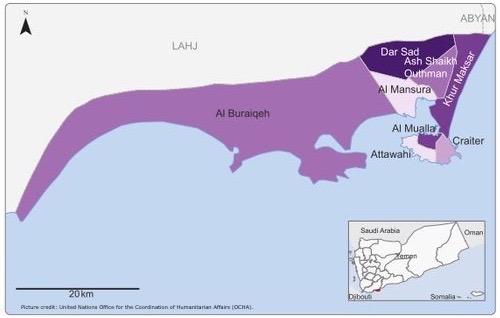
Geographical Scope: The Capital, Aden (Sheikh Othman, Al Mansoura, Al Mualla, Khormaksar, Al Buraiqeh, Dar Saad, Sira, Al Tawahi)
Overview
The comprehensive collapse of the electricity grid—highlighted by the shutdown of major power plants—has become the most dangerous indicator affecting daily life. Worsening supply crises and unregulated markets are now threatening food and pharmaceutical security, while rapidly shifting political polarization and the targeted assassination of developmental cadres compound urban risks and escalate societal tension.
A Success Story for the “Radar Aden” Platform
From Field Monitoring to Effective Response
Building on the “Radar Aden” platform’s efforts to transform field assessment data into tangible institutional responses that improve public policies and protect community health security, we are proud to document a high-level coordination success achieved during the first half of May 2026. Based on critical reports and indicators launched by platform volunteers in the previous March report regarding current epidemiological and health challenges, the Ministry of Public Health and Population registered an immediate, evidence-based government response. His Excellency the Minister of Health, Dr. Qasim Buhaibeh, interacted directly with these outputs, emphasizing the utmost importance of activating the role of the “Health Emergency Committee” as a supreme national mechanism to monitor health developments and enhance joint coordination among concerned authorities. This response culminated in a plan to elevate readiness levels, epidemiological surveillance systems, and early response capabilities to limit the spread of diseases. This achievement embodies the true value of community assessment as an effective tool to empower authorities, linking the pulse of the street with decision-makers at the highest political and executive levels.
Key Challenges and Field Indicators
1. Critical Service Collapse (Electricity, Water, and Health)
- Energy Crisis and Harsh Outage Pattern: A total electrical grid collapse with demand reaching 623 MW against a meager 254 MW of production. Outages reached a harsh pattern of only 2 hours of operation versus 5 hours of outages, extending up to 12 continuous hours during peaks. This culminated in the complete shutdown of the strategic “President Hadi Power Plant” on May 6.
- Water Crises and Random Networks: A significant decline in drinking water supplies, particularly in the “Dar Saad” district. This is driven by the transformation of the local network into unregulated, random connections, forcing the Water Corporation to restrict pumping quotas strictly to the actual number of officially registered subscribers.
- Health Sector Humanitarian Crisis: Catastrophic indicators are facing the Psychiatric Hospital due to severe power and service outages, resulting in an emergency intervention to provide a dedicated solar energy system to save inmates and improve the healthcare environment.
2. Security Deterioration and Criminal Files
- Assassination of Developmental Cadres: Security tensions escalated following the treacherous assassination of Mr. Waseem Qaid, Acting Director of the Social Fund for Development, reflecting a dangerous shift toward targeting active figures in developmental and international institutions.
- Uncovering Assassination Cells: The arrest of the direct perpetrators behind the Al-Shaer assassination revealed an alarming reliance on new, officially “unnumbered” soldiers affiliated with influential security and military formations (such as the Giants Brigades and National Security), highlighting the exploitation of this oversight vacuum to execute liquidations.
3. Commercial Activity and Food Security Risks
- Wheat Scarcity and Shrinking Bread Weights: A severe shortage of wheat stocks prompted a 20% approved price increase for local flour. Consequently, the size of white bread and Roti shrank, and the number of pieces sold per bag dropped from 5 to 4 (and down to 3 for red bread). Traditional alternatives for low-income families, like millet and red corn bread, have almost completely disappeared.
- Spoiled Goods and Smuggled Infiltrations: The open sale of expired products in markets is widespread amid weak oversight from the Ministry of Industry and Trade. Additionally, there is a dangerous influx of Israeli-origin canned goods and rerouted Iranian products entering via the UAE.
- Medicine Pricing Crisis: A continuous, sharp decline in the availability of essential pharmaceutical items, met with crazy and unjustified price hikes that double the burden on patients.
4. Public Mood and Political Entrenchment (Political Congestion and Polarization)
- Political Congestion and Community Polarization: Aden is experiencing severe popular and political tension fueled by two contradictory mobilization tracks: the May 4 celebrations by supporters of the (dissolved) Southern Transitional Council, and widespread announcements by activists intending to publicly celebrate the Yemeni Unity anniversary on May 22. This places the city on a hotbed of political polarization and raises fears of field clashes.
Response Roadmap (Key Urgent Recommendations)
- Security: Tighten strict administrative oversight on the files of new soldiers in military and security formations, integrate “unnumbered” elements to dry up the sources of assassination cells, and intensify proactive security patrols to protect relief and developmental cadres following the Social Fund director’s assassination.
- Services and Health: Immediate intervention from the Prime Minister’s office to provide power plant fuel and urgently restart the President Hadi plant to avoid a total grid collapse. The Local Water Corporation must address bottlenecks and random connections in Dar Saad, and the installation of the solar system for the Psychiatric Hospital must be expedited alongside the activation of the Health Emergency Committees.
- Supply and Economy: Activate the consumer protection sector to launch strict campaigns to confiscate expired goods sold openly in markets. Open an urgent official investigation into the entry of smuggled/rerouted foreign canned goods, and establish a strict mechanism to monitor bread weights, flour prices, and medicine costs to prevent the exploitation of citizens’ difficult humanitarian situations.
Detailed Report
Introduction
The capital, Aden, continues to face successive and harsh chapters of complex crises, where critical security deterioration intersects with a comprehensive service and supply collapse, placing the city and its residents under severe tension. In this documented field assessment for the first half of May 2026, features of a major service and humanitarian setback emerged, represented by the total collapse of the electrical power grid and the shutdown of strategic power plants. This occurred in parallel with a stifling supply crisis affecting the daily sustenance of citizens due to a severe shortage of wheat and the disappearance of bread varieties and basic food alternatives from the markets. On the security and political front, the city faced critical threats represented by the targeting of developmental cadres, with an escalation in the intensity of field and symbolic political polarization in the public sphere between competing forces.
In continuation of our established approach in the “Aden Radar” platform, this third edition aims to place the outputs of the documented community assessment through the eyes of the male and female volunteers of the Youth Committees before governmental entities, local authorities, and the international community. This report does not merely monitor suffering but provides a deep analytical reading of the “pulse of the street,” accompanied by an urgent response map to address overlapping crises and contain the state of general congestion before conditions slide to dangerous levels.
We place this report in the hands of government agencies, local authorities, and the international community, emphasizing that the lack of rapid response immediately translates into loss of lives and a deepening of the trust gap between the citizen and the state.
Impact of Previous Reports (A Success Story for the “Radar Aden” Platform)
From Field Monitoring to Effective Response
Building on the “Radar Aden” platform’s efforts to transform field assessment data into tangible institutional responses that improve public policies and protect community health security, we are proud to document a high-level coordination success achieved during the first half of May 2026. Based on critical reports and indicators launched by platform volunteers in the previous March report regarding current epidemiological and health challenges, the Ministry of Public Health and Population registered an immediate, evidence-based government response. His Excellency the Minister of Health, Dr. Qasim Buhaibeh, interacted directly with these outputs, emphasizing the utmost importance of activating the role of the “Health Emergency Committee” as a supreme national mechanism to monitor health developments and enhance joint coordination among concerned authorities. This response culminated in a plan to elevate readiness levels, epidemiological surveillance systems, and early response capabilities to limit the spread of diseases. This achievement embodies the true value of community assessment as an effective tool to empower authorities, linking the pulse of the street with decision-makers at the highest political and executive levels.
First: Basic Services and Public Institutions Crises (Comprehensive Collapse)
The public services sector in the capital, Aden, suffers from a state of complete structural collapse that goes beyond temporary breakdowns to an unprecedented operational deficit that threatens citizens’ daily livelihoods. This collapse is evident in the paralysis of the electrical generation grid, the decline in drinking water supplies due to randomness, and the tragic situation of specialized health facilities, amidst a clear governmental inability to find sustainable solutions, limiting remedies to theoretical discussions.
1. Record Electricity Collapse and Total Grid Shutdown
- Field Reality: The electrical energy crisis topped the service scene with record deficit numbers; the estimated generation demand for the city of Aden reached approximately 623 megawatts, while actual production did not exceed the 254-megawatt mark, registering a massive deficit estimated at 369 megawatts with harsher declines recorded at varying periods. This was reflected in the outage schedule, which reached a very harsh pattern averaging only two hours of operation versus five hours of outage, extending during certain peak periods to between 7 to 12 continuous hours. The situation worsened dramatically on May 6 following the shutdown of the strategic “President Hadi Power Plant,” causing a total collapse of the electrical grid, as generation in the remaining plants dropped to critical lows: Al Mansoura Plant (30 megawatts), Shahinaz Plant (7 megawatts), and Al Malaab Plant (7 megawatts).
- Community Impact: This long outage and total paralysis at the peak of summer led to a sharp deterioration in the living conditions of families, and a total absence of any radical remedies by the Ministry of Electricity, whose actions were confined to discussing the implementation of anti-illegal connection campaigns.
2. Solar Energy Market Rebound and Rising Popular Discontent
- Field Reality: As a result of despair over the return of government power, the solar energy systems market witnessed a sharp, sudden reverse jump in prices, after having recorded a noticeable drop of over 25% in previous periods, to rise again to levels exceeding what they were before. This service deterioration was accompanied by factions loyal to the (dissolved) Southern Transitional Council launching widespread calls for protests and taking to the streets.
- Community Impact: These protest calls were quickly met with widespread cynical community mockery by citizens; the street drew direct, disapproving comparisons between these current calls and the violent acts of repression practiced by the Transitional Council itself against demand-driven protest events and citizens who marched to improve service quality in previous years.
3. Drinking Water Crisis and Random Pumping Networks (Dar Saad District as a Model)
- Field Reality: A massive and sharp decline was recorded in the pumping operations of safe drinking water across various districts, with the “Dar Saad” district emerging as the most affected and declining area in water supply levels. Field reports attributed this water deterioration to the transformation of the vast majority of the district’s water network into a random network (nearly 600% of the network’s beneficiaries are connected illegally). In contrast, the Local Water Corporation adopted a pumping policy restricted only to quotas corresponding to the actual number of officially registered subscribers.
- Community Impact: This deficit deprived thousands of families in the neighborhoods of their fair share of water, doubling the living and financial burdens to secure costly alternatives.
4. Catastrophic Situation of Specialized Health Facilities (Psychiatric Hospital)
- Field Reality: Platform volunteers monitored extremely dangerous humanitarian and health indicators describing a catastrophic situation facing the “Psychiatric Hospital” in the city of Aden regarding services and electricity. In response to this humanitarian suffering, an emergency plan was approved to provide and grant the hospital an integrated solar energy system to ensure its continued operation.
- Community Impact: The hospital’s critical condition reflects the magnitude of risks surrounding inmates and psychiatric patients due to the power deterioration, making the provision of solar energy a necessary emergency step to save lives and improve services.
Second: Security and Political Dynamics (Security Lawlessness and Community Congestion)
The security and political scene in the capital, Aden, is experiencing a state of critical escalation and extreme security fragility, represented by the return of crimes liquidating developmental cadres, the discovery of organized assassination cells containing unnumbered elements within the ranks of security and military apparatuses, in parallel with a state of severe political polarization and congestion threatening community peace, and a noticeable increase in the spread and carrying of weapons, returning to a phenomenon that had almost ended.
1. Assassination of Developmental Cadres (Targeting the Social Fund for Development)
- Field Reality: The intensity of security lawlessness escalated following a treacherous assassination crime targeting Mr. “Waseem Qaid”, the Acting Director of the Social Fund for Development in Aden.
- Community Impact: The crime caused a state of shock and anxiety among local cadres and international institutions, as this targeting represents a dangerous indicator of the growing risks surrounding the operational environment of humanitarian and developmental institutions that directly serve the community.
2. Uncovering Organized Assassination Cells and Apprehending Culprits (Al-Shaer Case)
- Field Reality: Security authorities arrested the direct perpetrators of the Al-Shaer assassination operation. Field investigation records revealed the identities and work locations of the five involved individuals, which carried highly alarming indicators:
- R. N. Sh. (30 years old): Works in the private sector.
- Q. S. M. (26 years old): New unnumbered soldier in the Giants Brigades (Fourth Division).
- S. A. H. (27 years old): New unnumbered soldier affiliated with National Security in Abyan Governorate.
- A. A. A. (25 years old): New unnumbered soldier in the Giants Brigades (Fourth Division).
- F. A. J. (24 years old): New unnumbered soldier affiliated with National Security in Abyan Governorate.
- Community Impact: Revealing the details of the cell sparked a massive wave of community apprehension; given the cell’s reliance primarily on “new soldiers who do not possess official military numbers” and are affiliated with influential and varied security and military formations, highlighting the danger of the oversight vacuum and the exploitation of these elements in carrying out liquidation operations.
3. Public Mood and Political Polarization (Between the Anniversary of Establishment and Unity)
- Field Reality: Assessment reports monitored a state of extreme and noticeable popular and political congestion since the beginning of May. This congestion was fed by two contradictory polarizing tracks in the street; the first was the celebration by supporters of the (dissolved) Southern Transitional Council of the anniversary of the council’s establishment on May 4, and the second track was the widespread announcements and confirmations by loyalist activists of their intention to publicly celebrate the anniversary of achieving Yemeni Unity on May 22.
- Community Impact: These contradictory waves of mobilization and counter-mobilization placed the city in a state of alarming psychological anticipation and alertness, amid serious fears that this symbolic and media conflict in the public sphere could turn into field clashes affecting the security of residents already exhausted by service and economic woes.
Third: Market Movement and Food & Drug Security Indicators (Supply Shortages and Lack of Oversight)
The capital, Aden, faces a silent and highly concerning food and drug security crisis; represented by an unprecedented shortage in wheat and basic grain stocks, widespread manipulation of prices and weights, amidst an oversight vacuum that allowed the open trading of spoiled and expired goods in the commercial space.
1. Wheat Crisis and Disappearance of Bread Varieties and Food Alternatives
- Field Reality: The field team monitored a severe and massive shortage of wheat in the markets. As a result of this stock deficit, the government approved allowing local flour manufacturing companies a 20% increase as a measure to compensate for the shortage in the general stock. This coincided with the red wheat and red flour completely starting to disappear from sales outlets, and an almost total absence of traditional alternatives relied upon by poor families such as: millet bread, yellow corn bread, and Gharb (red corn), in addition to a noticeable decline in the availability of bran bread.
- Community Impact: This absence and direct price hike threaten the food security of thousands of families, depriving the most impoverished segments of cheap grain and bread alternatives they depend on for their daily sustenance.
2. Shrinking Weights of Bread and Roti and Decline in Citizens’ Purchasing Quotas
- Field Reality: The flour crisis reflected directly on the offered size of white bread and Roti; male and female volunteers recorded a clear decrease in the size of the sold pieces. The numerical quotas allocated per bag at sale also dropped to only 4 pieces instead of 5 for Roti and white bread, and decreased to only 3 pieces for red bread.
- Community Impact: This commercial policy represents an additional living burden on citizens, forcing large families to spend double amounts to secure enough of their daily meals of basic bread.
3. Influx of Spoiled Goods and Smuggled Commercial Infiltrations
- Field Reality: Assessment reports monitored a highly dangerous phenomenon represented in the sale and open display of expired food goods and products in markets and commercial shops, amid weak and feeble oversight campaigns by the Ministry of Industry and Trade. Market movement also witnessed an alarming appearance of Israeli-origin canned foods, as well as tracking a steady increase in the numbers of Iranian products re-routed and exported via the United Arab Emirates.
- Community Impact: This regulatory and commercial lawlessness exposes consumers’ health security to the risk of poisoning and diseases, and carries dangerous implications regarding the lack of firm oversight at distribution ports inside the city.
4. Pharmaceutical Sector Crisis and Decreasing Supply
- Field Reality: The medical and pharmaceutical supplies sector continues to record negative indicators; represented by a continuous, daily decrease in the availability of essential medicinal items in warehouses and pharmacies. This severe shortage is met with successive and noticeable price hikes.
- Community Impact: This crisis multiplies the tragedies of patients and low-income individuals, turning access to basic medicine into a financial burden exceeding the living capacities of service-exhausted families.
Fourth: Food Security Indicators and Rumors Table
1. Food Security and Price Indicators
Markets reflect a state of confusion and lack of oversight that directly impacted food and drug security. Despite prices not stabilizing at specific numbers due to continuous fluctuation, supply indicators are manifested in the following:
- Wheat and Flour: A massive shortage in general supply, prompting the government to approve a 20% price increase for local manufacturing companies to compensate for the stock deficit.
- Bread (Roti and White): Noticeable decline in size and weight, and a drop in the citizen’s purchase quota to 4 pieces per bag instead of 5.
- Red Bread: Gradual disappearance of red wheat and red flour from markets, and a drop in the number of pieces sold to citizens to only 3 pieces per bag.
- Grain Alternatives: Almost total absence of traditional alternatives relied upon by low-income families such as: (millet bread, yellow corn bread, and Gharb/red corn), with a significant decline in the availability of bran bread.
- Consumer Goods (Violations): Open trading of expired food goods and products amid the weakness and total neutrality of Ministry of Industry and Trade oversight campaigns, coinciding with an influx of Israeli-origin canned goods, and a noticeable increase in Iranian products re-exported from the UAE.
- Medicines: Continuous and sharp decline in the availability of medicinal items met with a steady rise in prices.
2. Table of Rumors and Their Psychological Impact
The field assessment shows the circulation of some rumors and calls reflecting the state of polarization and congestion in the Aden street during May 2026:
| Rumor Type | Rumor Details | Public Belief/Credibility |
|---|---|---|
| Political / Security | Outbreak of field clashes and security tensions coinciding with activists announcing the celebration of the Unity anniversary on May 22 versus the celebrations of Transitional Council supporters on May 4. | High: Creates a state of congestion and security anticipation, placing the street on a hotbed. |
| Service / Community | Calls for field protests launched by female activists loyal to the (dissolved) Transitional Council denouncing the deterioration of electricity service. | Very Weak (Community Mockery): Met with widespread sarcasm as the council itself previously repressed those demanding service improvements. |
Detailed Indicators by District
| District | Services and Infrastructure Status | Safety and Urban Environment | Public Mood and Security Situation | Status Level |
|---|---|---|---|---|
| Dar Saad | 🔴 Critical: Severe and massive decline in pumping water to subscribers. | ⚠️ The majority of the water network has become random. | 🔴 Critical: Congestion due to the policy of pumping water only to the actual number of subscribers. | Concerning leaning Critical (Red) |
| Al Mansoura | 🔴 Critical: Electricity generation dropped to only 30 megawatts following grid collapse. | ⚠️ Commercial environmental deterioration affected by long electricity outages. | ⚠️ Concerning: Supply discontent over shrinking Roti sizes and disappearance of goods. | Critical (Red) |
| Sheikh Othman | ⚠️ Fluctuation in services affecting facility operations. | 🔴 Critical: Catastrophic situation facing the Psychiatric Hospital (lack of services and electricity). | 🔴 Very Critical: Massive shock and extreme security tension following the assassination of the Social Fund for Development director. | Critical (Red) |
| Khor Maksar | 🔴 Critical: Shahinaz plant generation dropped to 7 megawatts. | ⚠️ Infrastructure damaged following the total energy collapse on May 6. | ⚠️ Concerning: Cautious political anticipation between May 4 and May 22 events. | Concerning (Yellow) |
| Al Mualla | 🔴 Critical: Al Malaab service plant dropped to 7 megawatts. | ⚠️ Severe negative backlash on market and bakery movements. | ⚠️ Concerning: Community mockery and sarcasm regarding pro-Transitional Council protest calls. | Concerning (Yellow) |
| Al Tawahi | ⚠️ Harsh electricity outages (2 hours operation vs. 5 hours outage). | ⚠️ Public life affected and burdens increasing with the onset of summer. | ⚠️ Concerning: General discontent over the Ministry of Electricity’s inability, limited to discussions. | Concerning (Yellow) |
| Seera | ⚠️ General grid deterioration since the President Hadi plant shutdown. | ⚠️ Renewed and massive spike in solar energy system prices. | ⚠️ Concerning: Discontent over the lack of oversight on expired goods. | Concerning (Yellow) |
| Al Buraiqeh | 🟢 Institutions operating relatively normally compared to others. | ⚠️ Relatively stable with fears of water randomness spreading. | ⚠️ Concerning: Discontent over the continuous decrease in medicines and their rising prices. | Stable (Green) |
Urgent Recommendations for Relevant Authorities (Response Roadmap)
Based on reading the vital and dangerous indicators brought by the first half of May, the “Aden Radar” platform places the following immediate intervention package before decision-makers and relevant authorities:
1. To the Supreme Security Committee and Aden Security Directorate (Combating Assassination Cells and Protecting Cadres)
- Tighten strict administrative and security oversight over the files and recruitment records of new elements in all military and security apparatuses and units (especially the Giants Brigades and National Security), and prohibit the rotation or use of “officially unnumbered” elements to close the avenues for organized assassination cells.
- Establish a proactive and intensive security plan to protect developmental and local cadres and figures working in international and local institutions following the unfortunate incident of the assassination of the Acting Director of the Social Fund for Development.
- Take strict field measures to prevent field frictions and ensure peaceful expression, coinciding with the state of political polarization and mobilization tied to the May events.
2. To the Ministry of Electricity and the Local Water Corporation (Addressing Basic Services Paralysis)
- Immediate emergency intervention to provide fuel for generation plants and repair technical faults to urgently return the “President Hadi Plant” to service, avoiding the total and continuous collapse of the energy grid and the decline of other plants.
- The Ministry of Electricity must move from the stage of theoretical discussions and proposals to the actual and organized implementation of anti-illegal connection campaigns without selectivity.
- Compel the Local Water and Sanitation Corporation to address bottlenecks and the randomness of the pipe network in the “Dar Saad” district, and establish fair distribution standards that protect the rights of officially registered subscribers.
3. To the Ministry of Public Health and Population and its Offices (Saving the Health and Drug Situation of the Street)
- Expedite the completion of technical arrangements to install and operate the approved solar energy system for the “Psychiatric Hospital” to save the inmates and end the catastrophic services and electricity situation inside the hospital.
- Immediately initiate the activation of the Minister of Health’s directives regarding operating health emergency committees as a national mechanism to monitor developments, and enhance early epidemiological surveillance systems.
- Activate pharmaceutical inspection committees to control the decline in stock and combat the successive and crazy hikes in medicine prices in commercial pharmacies.
4. To the Ministry of Industry and Trade and its Office in the Capital (Protecting Food Security and Markets)
- Launch firm, strict, and continuous oversight and inspection campaigns on all commercial shops and complexes to seize, confiscate, and destroy expired food goods sold openly in the markets.
- Open an official and urgent investigation to find out how Israeli-origin canned goods and rerouted Iranian products entered and were smuggled, and withdraw them immediately from the commercial space to protect consumers.
- Impose strict oversight on the weights and prices of bread and Roti pieces in bakeries and ovens, and put in place urgent remedies that ensure the provision of wheat and flour to protect the citizen from greed and market manipulation.
 Radar Aden | منصة رادار عدن