


First Edition | Report Date: March 2026
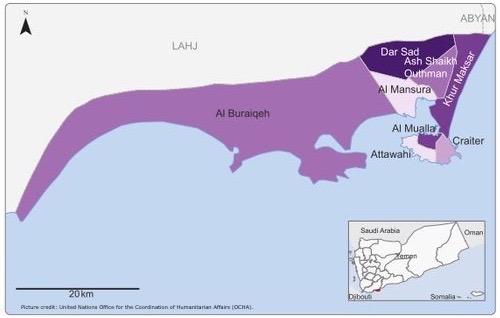
Geographical Scope: The Capital, Aden (Sheikh Othman, Al Mansoura, Al Mualla, Khormaksar, Al Buraiqeh, Dar Saad)
Field Report Summary
Overview
This report summarizes the outcomes of the field monitoring and community assessment conducted by over 200 young volunteers from the National Network for Community and Youth Initiatives across 6 main districts in the capital, Aden, during the month of Ramadan. The report aims to accurately and impartially convey the pulse of the street, highlighting service crises, urban risks, and economic and community dynamics, while providing an urgent response roadmap for authorities and decision-makers.
Key Challenges and Field Indicators
1. Service Collapse and Economic Security
- Gas Market Chaos: A complete lack of domestic gas through official agents, and an unprecedented boom in the black market and commercial stations that have raised refill costs to 9,000 YER instead of the official price of 3,000 YER, doubling the economic burden on families.
- Water Crises (Contamination and Mismanagement): A health disaster was observed in the Al-Mahariq neighborhood in Sheikh Othman, where drinking water is mixing with salty well water. In Al Mualla, artificial cuts were observed in Al-Qalou’a to divert water to other areas, along with sewage overflow coinciding with drinking water pumping times in the Radfan neighborhood.
- Electricity and Fuel Crisis: Continued severe fluctuations and power outages lasting up to 8 continuous hours (in Al Mansoura and Al Mualla), driven by the rising prices of imported fuel, leading to the paralysis of evening commercial activities.
2. Urban Environment and Daily Risks
- Rain Fallout: Despite the authorities’ success in draining main streets in record time (within 48 hours), the lack of internal drainage networks led to the flooding of school yards and destruction of property in Al Mualla, Sheikh Othman, Dar Saad, and Khormaksar.
- Urban Traps and Traffic Chaos: The spread of uncovered cesspools, hazardous electrical wiring, and garbage accumulation (Bir Ahmed, Dar Saad, and Al Buraiqeh), with severe traffic bottlenecks and accidents, primarily in Al Mansoura.
- Spread of Fevers: A noticeable increase in fever cases (in Sira, Khormaksar, Al Mualla, and Al Mansoura) due to the spread of mosquitoes and the lack of adequate healthcare.
3. Public Sentiment (Economic Anxiety and Community Resilience)
- A Silent Economic War: Profound economic anxiety due to the local cash liquidity crisis, which citizens view as an internal economic war, with strong rumors about new cash injections and impending fuel price hikes threatening a new wave of inflation.
- Vitality of the Civic Space: Civil society demonstrated high cohesion through successful large and peaceful Ramadan events (million-man sit-ins, massive collective iftars, and cultural evenings) in a safe, tension-free atmosphere.
Response Roadmap (Key Urgent Recommendations)
- Economically: Combat the black market for domestic gas, control its pricing and distribution, and coordinate with the Central Bank to boost cash liquidity and stabilize markets.
- Health and Environmentally: Immediate engineering intervention to separate drinking water from salty wells in Al-Mahariq, repair sewage networks to prevent contamination in Al Mualla, and enhance mosquito control efforts.
- Urban: Fence open pits, secure electrical wiring, intensify waste removal, and deploy traffic units to clear bottlenecks and regulate informal markets to protect citizens’ lives.
Detailed Report
Introduction
The capital, Aden, is going through a critical phase where economic and service crises intersect with environmental and security challenges, creating a highly complex daily reality that burdens citizens. Amidst this rapidly evolving scene, there is an urgent need for reliable, impartial information sources capable of cutting through rumors and ambiguity to provide an accurate reading of the “pulse of the street” as it is on the ground.
Hence, this first detailed report for the “Aden Radar” platform serves as a living community document for early warning and field assessment. This report was not written in closed offices; rather, it was drafted by the hands and eyes of young men and women from the volunteer youth committees, who spread across various neighborhoods and districts of Aden, meticulously monitoring the level of basic services, the state of infrastructure, and public sentiment trends during this exceptional period coinciding with the holy month of Ramadan.
We at the “National Network for Community and Youth Initiatives” realize that assessing the problem is only half the solution; the other half lies in delivering this assessment to the decision-makers’ table. Therefore, this report does not merely list accumulated crises—from domestic gas queues to water contamination and the fluctuating collapse of electricity—but dives into analyzing the community and economic impacts of these crises, presenting a clear “response roadmap” and practical, actionable recommendations.
We place this report in the hands of government entities, local authorities, international and local organizations, and the community at large, to serve as a guiding tool that supports urgent interventions, promotes transparency and accountability, and helps shift efforts from “temporary reactions” to “evidence-based responses targeting real needs” to ensure the security, safety, and dignity of the citizens in Aden.
First: Basic Service Crises (Urgent Call for Response)
The fluctuating collapse of basic services dominates the daily scene for citizens in the capital, Aden, going beyond a mere “shortage of services” to become a real threat to the human and economic security of families. Four critical challenges have emerged requiring urgent and decisive intervention by local authorities and decision-makers:
1. Domestic Gas Crisis and Black Market Expansion (Critical Economic Indicator)
- Field Reality: A sharp decline was observed in the availability of domestic gas cylinders through official neighborhood agents, restricted only to “commercial filling stations,” whose supplies, in turn, have dropped to being restocked every 3 days instead of daily, especially in the districts of (Sheikh Othman and Al Buraiqeh). This crisis is accompanied by widespread “smuggling” and leakage of gas outside official channels, as it is traded among residents.
- Community Impact: The lack of pre-filled gas cylinders has forced citizens to stand in extremely long queues to refill their cylinders directly at the stations at double the price; refill costs have jumped to 9,000 YER per cylinder instead of the official, normal price of 3,000 YER. This monopolistic situation has doubled the economic and psychological burden on families, particularly with the increased consumption demand during Ramadan, forcing some to cut back on other basic expenses to secure gas.
2. Water Contamination Risks and Health Security Threats (Sheikh Othman District)
- Field Reality: Residents of the “Al-Mahariq” neighborhood face a complex and dangerous crisis; besides the severe weakness and prolonged interruption in pumping drinking water (project water), a direct mixing of drinking water with salty groundwater from wells was documented due to chronic overlapping and damage in the dilapidated pipe network and its intersection with leaking cesspits.
- Community Impact: This indicator serves as a “ticking health time bomb” threatening the spread of waterborne diseases and epidemics. Residents find themselves forced to use this undrinkable water given the lack of alternatives, placing the lives of children and the elderly in direct danger. This requires an urgent investigative intervention to determine the causes and locations of the problem and address it with emergency engineering and health measures to replace and isolate the damaged lines.
3. Mismanagement of Water Distribution and Accompanying Environmental Disasters (Al Mualla District)
- Artificial Cuts (Al-Qalou’a Neighborhood): The water crisis here is not due to source scarcity, but rather “mismanagement and distribution.” Al-Qalou’a residents suffer from severe cuts and deprivation of their water share, which locals attribute to authorities running water pumps at full capacity to benefit neighboring areas (Sheikh Ishaq neighborhood), reflecting a lack of fairness in resource distribution and creating regional tensions.
- Simultaneous Sewage Overflow (Radfan Neighborhood – Saudi Project): A chronic sewage overflow was observed that consistently and directly coincides with the drinking water pumping times (Water Zam). This coincidence prevents citizens from safely storing clean water and floods the streets with waste.
4. Fluctuating Collapse of Electricity Service and Imported Fuel Repercussions
- Field Reality: The severe fluctuation in electricity service continued (reaching up to 8 continuous hours of outages in Al Mansoura and Al Mualla). This collapse coincides with the availability of fuel from Hadramout as well as the rising prices of imported fuel due to global price increases, complicating efforts to stabilize the grid.
- Community Impact: This prolonged outage, specifically in the evenings, led to increased costs for evening commercial movement and added to the suffering of shop owners and small businesses who incur extra losses to secure fuel for private generators (diesel), which itself is facing a supply crisis. Ultimately, this reflects on higher commodity prices for the ordinary citizen.
Second: Urban Environment and Public Safety (Infrastructure Fragility and Daily Risks)
Field monitoring revealed unprecedented exposure and fragility in the infrastructure and public facilities in the capital, Aden. These challenges are no longer merely a “lack of maintenance” but have become direct, daily threats to the physical and health safety of citizens, emerging in three main areas:
1. Climate Change Fallout and Educational Infrastructure Fragility (Al Mualla District)
- Field Reality: For the first time in the capital, Aden, the platform recorded an unprecedented positive response from authorities in dealing with rainwater; rainwater was drained and pumped from main streets (like the main street in Al Mualla, which was recently rehabilitated) in just 48 hours, compared to the usual 12 to 14 days in previous years.
- Community Impact: Despite this significant and commendable improvement in open streets, the lack of internal drainage networks in closed facilities turned school yards (such as Al-Rawda and Muheirez schools in Al Mualla) into stagnant pools, damaging educational property (chairs and equipment). This requires transferring the successful “rapid pumping” experience from the streets to secure vital facilities. It also calls for re-engineering the recent updates to the main street in Al Mualla to allow water to drain smoothly without barriers obstructing the drainage process.
2. Neglected Urban Risks and Environmental Threats (Bir Ahmed and Dar Saad)
- Field Reality: Male and female field volunteer teams witnessed a series of “urban traps” left unaddressed, most notably the presence of deep, uncovered holes (unfenced cesspits) in streets and side neighborhoods, accompanied by the dangerous, random entanglement of exposed electrical wiring. This coincided with a striking and alarming accumulation of solid waste in residential neighborhoods, which accelerated significantly with higher consumption rates during Ramadan days.
- Community Impact: These violations place the lives of pedestrians, especially children, at risk of fatal falls or electrocution. On the other hand, the untreated accumulation of garbage amid rising temperatures provides a fertile environment for insect vectors and epidemics to breed, requiring an urgent mobilization of the Cleaning and City Improvement Fund, and intervention by emergency electricity services to secure the exposed wires.
3. Traffic Chaos and Lack of Road Safety (Al Mansoura District as an Example)
- Field Reality: Major vital roundabouts and intersections (such as Caltex Roundabout, Textile Roundabout, and Cairo Roundabout) are experiencing severe traffic bottlenecks and near-total paralysis of movement, resulting from randomness, the unregulated expansion of street vendor stalls, and a clear absence of effective traffic regulation during Ramadan peak hours.
- Community Impact: The impact of this chaos was not limited to wasting citizens’ time and increasing psychological pressure but evolved into a direct threat to lives. A horrific traffic accident was recorded in Al Mansoura (a car crashed into the glass facade of a shop, running over a young worker), a direct result of the lack of traffic safety controls and reckless speeding on crowded streets. This scene places traffic police and local authorities before an inevitable responsibility to restore discipline to the capital’s streets and protect the lives of pedestrians and workers.
Third: Public Sentiment and Community Dynamics (Street Pulse and Early Warning Indicators)
The “pulse of the street” in the capital, Aden, during this period reflects a complex duality; while the community shows remarkable resilience and cohesion in the face of crises, a state of “cautious anticipation” and economic and security apprehension dominates public sentiment. These dynamics have manifested in the following areas:
1. Internal Economic War and “Economic Anxiety” Syndrome
- Field Reality: Despite the seasonal recovery of market traffic (reaching up to 100% across all districts), citizens face a severe cash liquidity crisis in addition to the return to using small denomination notes such as 100 YER. The “lack of local cash” in the markets is viewed as a form of internal economic warfare directed against citizen stability. Additionally, cases were documented of exchange offices refraining from exchanging foreign currency beyond 100-200 SAR or 50-100 USD at the official rate, while amounts exceeding that are exchanged at lower rates.
- Impact and Analysis: The platform operates as an “early warning system,” detecting the dominance of strong rumors suggesting the government is preparing to “inject new cash liquidity of the 1,000 YER denomination worth nearly 3 billion.” This is accompanied by clear financial confusion; although the exchange rate provided by the Central Bank is considered better and more stable than the black market rate, the lack of liquidity and the rise in global imported fuel prices fuel rumors of an impending “new price hike.” This drives merchants to hoard and threatens a wave of inflation that will devour families’ purchasing power.
2. Community Cohesion and Civic Space Vitality (Power of Resilience)
- Field Reality: In stark contrast to the harshness of the service and economic crises, civil society in Aden demonstrated strong immunity and a fierce desire to maintain normalcy and social solidarity. A wonderful momentum of Ramadan events initiated by youth and community groups was documented, most notably: the massive youth gathering at the (Bachelors’ Iftar) and several other iftars, the solidarity event at the (Al-Mamdara Martyrs’ Iftar), and the positive feminist activity embodied in the (Ramadan Cultural Evenings for Young Women) organized by the Badeel Foundation, as well as the Coffee Festival and Aden Mall Festival.
- Impact and Analysis: This scene carries a profound indication of the vitality of the civic space in Aden. The success of these mass events and their continuation for hours in safe atmospheres, devoid of any security frictions or community tensions, reflects a high degree of peaceful maturity. It confirms that the local community possesses its own tools for psychological recovery and creating safe spaces for youth and women away from political polarization.
3. Security and Geopolitical Apprehensions (Repercussions of Regional Conflict)
- Field Reality: Alongside economic concerns, the general mood remains affected by major military shifts. Volunteers (specifically in the Al Mualla and Crater neighborhoods) picked up on growing popular discussions and fears about the possibility of the situation sliding into a new military escalation that might target waterways and straits, with its impact extending to threaten direct stability in the capital, Aden. Furthermore, there is talk of weapons being distributed to supporters of certain groups, hate speech from some leaders of these groups, and clashes occurring due to government entities reclaiming control over government facilities that were used by the dissolved Southern Transitional Council as headquarters.
- Impact and Analysis: This geopolitical concern adds another layer of psychological pressure on citizens, rendering the current state of “stability” a stability fraught with anticipation. This apprehension also explains why large segments of society insist on showing public support for certain local political or security entities, viewing them as a protective umbrella in the event of any widespread security emergency.
Detailed Indicators by District
1. Sheikh Othman District
| Indicator | Field Evaluation | Level |
| Services & Infrastructure Status | ⚠️ Mixing of drinking water with salty wells (critical indicator), electricity fluctuation. | Critical (Red) |
| Safety & Urban Environment | ✅ General security stability, no heavy military deployment. | Stable (Green) |
| Public Sentiment & Activity | 🤝 General calm, execution of peaceful protests and safe civil events. | Level: Positive (Green) |
2. Al Mansoura District
| Indicator | Field Evaluation | Level |
| Services & Infrastructure Status | ⚠️ Electricity fluctuation (4-8 hours running time), severe traffic congestion. | Moderate (Yellow) |
| Safety & Urban Environment | 🔴 Fire in a commercial center, localized night raids, traffic accidents. | Concerning (Red) |
| Public Sentiment & Activity | 🤝 Anxiety over tensions, countered by notable religious and community activity. | Mixed (Yellow) |
3. Al Mualla District
| Indicator | Field Evaluation | Level |
| Services & Infrastructure Status | 🔴 Severe water cuts (Al-Qalou’a neighborhood), and chronic sewage overflow (Radfan neighborhood). | Critical (Red) |
| Safety & Urban Environment | 🔴 School halls flooded by rain, heavy military deployment and checkpoints. | Concerning (Red) |
| Public Sentiment & Activity | ⚠️ Popular geopolitical fears of a military escalation targeting the city and straits. | Anxious (Yellow) |
4. Bir Ahmed District
| Indicator | Field Evaluation | Level |
| Services & Infrastructure Status | 🔴 Severe gas crisis, long queues, and hoarding by stations. | Critical (Red) |
| Safety & Urban Environment | 🔴 Unfenced pits, tangled exposed electrical wires, and garbage accumulation. | Concerning (Red) |
| Public Sentiment & Activity | ⚠️ Clear popular discontent over the lack of service oversight. | Tense (Yellow) |
5. Al Buraiqeh District (and Salah Al-Din)
| Indicator | Field Evaluation | Level |
| Services & Infrastructure Status | 🟢 100% market traffic recovery, with gas shortages. | Good (Green) |
| Safety & Urban Environment | ✅ Security stability, and normal transportation movement. | Stable (Green) |
| Public Sentiment & Activity | ⚠️ Spread of strong rumors about injecting new cash liquidity and fears of inflation. | Alert (Yellow) |
6. Dar Saad District
| Indicator | Field Evaluation | Level |
| Services & Infrastructure Status | ⚠️ General stability with a lack of documentation of sub-crises. | Moderate (Yellow) |
| Safety & Urban Environment | ⚠️ Observations about garbage accumulation in some streets, with normal movement. | Moderate (Yellow) |
| Public Sentiment & Activity | ✅ Calm and normal practice of Ramadan activities. | Stable (Green) |
Urgent Recommendations for Relevant Authorities (Response Roadmap)
Stemming from community responsibility, and based on an accurate reading of the field data and risks documented in this report, the “Aden Radar” platform places the following urgent recommendations on the table of decision-makers and executive bodies, as proactive steps to prevent crises from worsening into disasters:
1. For the Presidential Leadership Council, the Cabinet, and the Yemeni Gas Company (Economic Crisis Management)
- Securing Gas Shipments and Fighting the Black Market: Immediate intervention to end citizens’ suffering in queues by providing gas cylinders through official agents at the normal price (3,000 YER), and halting “smuggling” and leaking operations of gas to commercial stations that sell it at exploitative prices (9,000 YER). Clear lists of districts’ shares and their arrival dates must be announced.
- Boosting Cash Liquidity: Coordinate with the Central Bank to ensure the availability of local cash liquidity in the markets to mitigate the psychological repercussions of the economic war and alleviate the inflation of the black exchange market.
2. For the Local Authority and the Local Water and Sanitation Corporation (Water and Environmental Security Emergency)
- Engineering and Health Intervention in “Al-Mahariq”: We demand the formation of an emergency engineering team to immediately deploy to the Al-Mahariq neighborhood (Sheikh Othman) to separate and isolate the overlap between the drinking water network and salty well water. The continuation of this contamination threatens an irreversible epidemic disaster.
- Re-evaluating Distribution in “Al Mualla”: The water pumping mechanism and load distribution between Al Mualla’s neighborhoods must be reviewed (specifically doing justice to the Al-Qalou’a neighborhood) to ensure fair distribution and not deprive some areas for the benefit of others.
- Addressing the Disastrous Coincidence in “Radfan”: We recommend developing a radical solution for the dilapidated sewage network in the Radfan neighborhood (Saudi Project), and separating drinking water pumping times from peak hours that lead to sewage overflow, to protect clean water from contamination during storage.
3. For the Local Authority, the Cleaning and City Improvement Fund, and Public Works Offices (Urban Safety)
- Waste Emergency Plan: Launch intensive and scheduled campaigns to remove accumulated solid waste in the streets of (Bir Ahmed and Dar Saad), taking into account the increased rate of consumption and excretion during Ramadan, to avoid the breeding of insects and epidemics with rising temperatures.
- Securing “Urban Traps”: Compel contractors and relevant authorities to immediately fence deep holes and uncovered cesspits. We also recommend urgent coordination with the “Public Electricity Corporation” to deploy, secure, and isolate exposed wire networks to protect the lives of pedestrians and children.
- Enhancing Public Health: By conducting mosquito control campaigns to reduce the spread of fevers in various areas in coordination with the Ministry of Public Health and the National Malaria and Mosquito Control Program.
4. For the Traffic Police Department and Security Apparatuses (Public Discipline)
- Managing Traffic Bottlenecks: Deploy additional traffic police units at heavily congested vital intersections (like the Al Mansoura and Sheikh Othman roundabouts), especially during peak hours, and compel informal street vendors to step back from main traffic lanes to avoid the recurrence of horrific traffic accidents.
- Preparing for the Rainy Season: Joint coordination with Civil Defense to ensure the readiness of water pumping vehicles in historically affected districts (like Al Mualla), to protect public facilities and schools from future flooding and damage.
 Radar Aden | منصة رادار عدن
Response
[…] Read this report in English […]
LikeLike